












At Vacation Rental World Summit (VRWS), held in Lyon on 8–9 October 2026, speakers from AirDNA, KeyData, Expedia Group/Vrbo, PriceLabs, Boom and Wheelhouse examined how vacation rental businesses are changing. We selected seven practical lessons for professional property managers: how demand is shifting, how to protect margins and where automation can improve operations.
VRWS 2026 in numbers
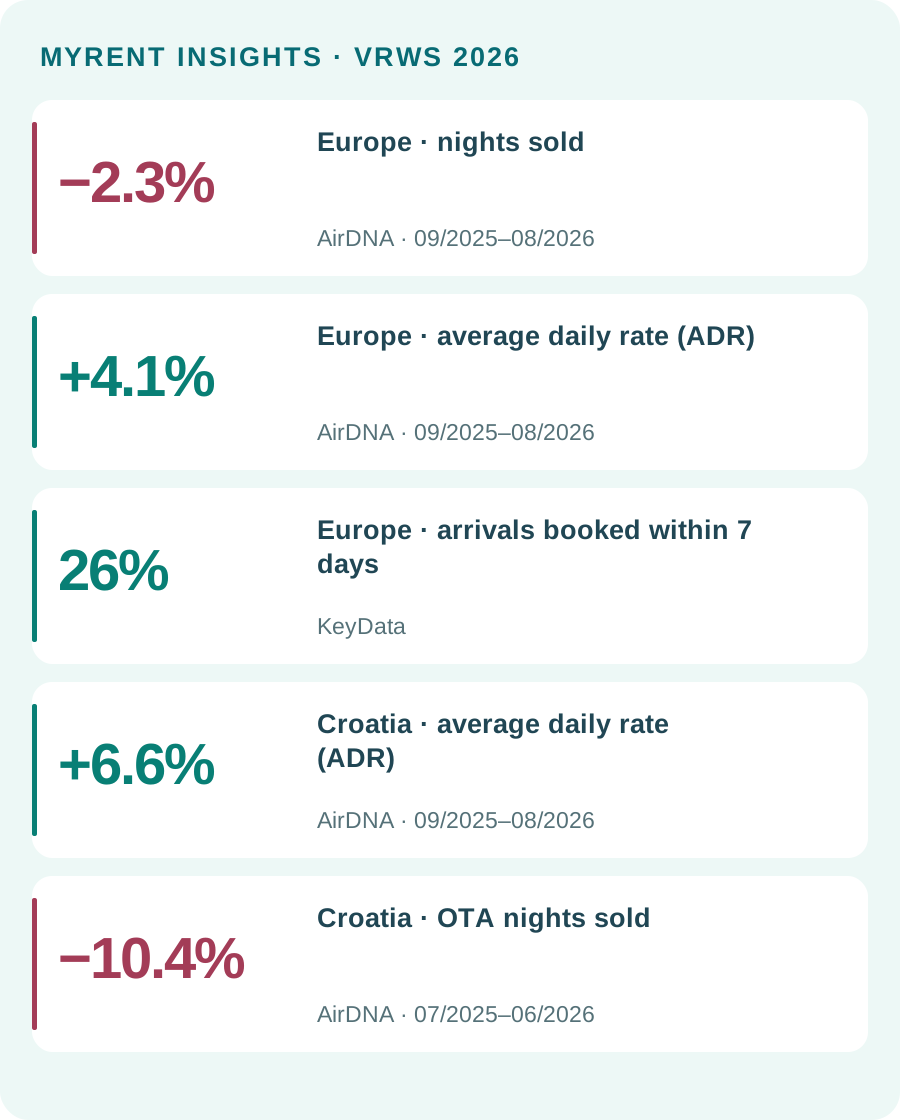
Data sources: AirDNA (Europe: 12 months to August 2026; Croatia: ADR to August and OTA nights to June 2026) and KeyData (sample of its own clients). The figures have different coverage; −10.4% concerns nights sold through major OTA platforms, not total tourism overnight stays.
1. Sold nights and daily rates are moving in different directions
Across continental Europe, AirDNA reported 413.7 million demand nights in the 12 months to August 2026 (−2.3% year on year), an average daily rate of €131.15 (+4.1%), occupancy of 57.7% (−1.5 percentage points) and RevPAR of €75.71 (+1.6%). A higher ADR does not automatically mean higher profits. Track occupancy, RevPAR, distribution costs and net revenue by property. These figures describe AirDNA's monitored segment, not all official tourism overnight stays.
2. Guests book later and stay for shorter periods
In KeyData's sample of direct clients, bookings made less than seven days before arrival represented an average of 26% of European arrivals, up eight percentage points. Average peak-summer stays shortened to about 5.4 days. Booking behaviour varies by property: smaller units tend to have a later booking mix, while larger homes are more frequently reserved well in advance. Segment pricing and booking restrictions instead of applying a single rule across a portfolio.
3. Direct bookings and OTAs play different roles
In KeyData's European sample, Booking.com and Airbnb together accounted for 82% of bookings made less than seven days in advance. By contrast, direct bookings represented 68.9% of bookings made at least 180 days ahead. These are shares within each booking window, not overall market shares. Build a returning-guest database and a strong direct booking experience, while keeping OTA availability accurate for last-minute demand.
4. Trust and quality matter at the point of booking
Vrbo presented Built to Stay research surveying 1,758 vacation rental travellers in seven markets. Respondents value accurate photos, cleanliness, reliable amenities, transparent charges and responsive hosts. Expedia Group's publicly released findings reported that 86% would pay more for a higher-quality listing. That is a stated preference, not a guaranteed price premium. Listing accuracy and service standards are part of your commercial strategy.
5. Revenue leaks often hide in everyday processes
PriceLabs and Rent4Rest highlighted five revenue leaks: operational firefighting, outdated listing content, static minimum-stay rules, a lack of weekly pacing benchmarks and manual owner reporting. A two-night calendar gap cannot be sold if a five-night minimum stay remains active. Before discounting an apparently empty calendar, review these restrictions and compare pickup and RevPAR against the same point last year.
6. AI is moving beyond chat towards operations
Boom's Moran Goldboim used a hypothetical 200-home manager dealing with 400 messages and 60 turnovers to illustrate a company intelligence layer connecting guest arrivals, cleaning, maintenance and owner queries. Wheelhouse discussed reusable AI skills between conversational prompts and custom software development. These are examples of an emerging approach, not proof that every current tool can perform every task autonomously. Start with supervised workflows, clear permissions and measurable results.
7. Growing a portfolio requires repeatable standards
AirDNA highlighted how PMS connectivity becomes more common as portfolios grow, but scaling software usage does not itself guarantee the guest experience. Cleaning standards, arrival procedures, owner reporting and accountable assignments need to scale alongside units. The relevant outcome is reliable service and profit per property, not portfolio size alone.
The Croatian context: what these changes mean for agencies and professional hosts
AirDNA reports Croatian ADR up 6.6% in the 12 months to August 2026 and nights sold in homes listed on major OTAs down 10.4% in the 12 months to June 2026. The sources are slides 28 and 23. A higher average rate alone does not prove better agency or owner performance. Compare net revenue after commissions and costs over the same period and property availability.
For a Croatian portfolio, review apartments, holiday homes and villas separately, and distinguish shoulder periods from peak season. For an apartment booking late, check prices, availability and minimum stays for the next 7, 14 and 30 days. For a villa booking earlier, compare booking pace with the same date last year. A European average is not a forecast for every Adriatic property.
A shorter booking window needs an agreed team response: who changes rates, follows up enquiries and confirms the property is ready? A booking for tomorrow should promptly trigger guest instructions and cleaning preparation. Develop direct bookings alongside effective OTA distribution; fewer OTA nights do not prove that guests switched to direct booking.
What to check before next season
- Compare ADR, occupancy, RevPAR and net revenue by property and channel over the same period.
- Segment results by destination, property type and season; track booking lead times.
- Assign responsibility for monitoring availability and new bookings for the next 7, 14 and 30 days, with clear response times.
- Check that calendar gaps can actually be booked under current minimum-stay and arrival rules.
- Review rates, commissions, photos and descriptions on OTAs and the direct booking journey.
- Document the late-booking process: guest response, arrival instructions, cleaning and team responsibility.
- Automate one recurring task and review handling time, exceptions and human oversight.
The MyRent perspective: shorter booking windows need faster responses
Less time between booking and arrival means pricing, availability and operations need to work together. Regular rate management, clear processes and supervised automation help teams respond promptly. MyRent connects PMS, Channel Manager, reservations, guests and operational tasks, supporting distribution, daily operations and the revenue management process. Results still depend on demand, rules and your team’s decisions.
Sources: VRWS Lyon talks, 8–9 October 2026, by AirDNA, KeyData, Expedia Group/Vrbo, PriceLabs/Rent4Rest, Boom, Wheelhouse and Sab Mulligan. The sources cover different samples and timeframes; MyRent's recommendations are interpretations, not speakers' forecasts.
Download the AirDNA presentation (VRWS 2026)
See how MyRent helps travel agencies
See where your agency could save time and protect revenue
In a focused MyRent demo, we will review how your team manages bookings, pricing, calendar gaps and day-to-day tasks. Tell us how many properties you manage and your biggest challenge; we will show the existing MyRent features relevant to your workflow.


